Understanding Wood Siding
Everything Worth Knowing About Wood Siding for Ruther Glen, VA Homes
Why Homeowners Still Choose Wood Despite the Maintenance
Wood siding has been losing market share to vinyl and fiber cement for decades. That fact alone tells you something: homeowners who choose wood are making a deliberate decision. They want what wood actually provides, which is a quality that manufactured alternatives have spent billions of dollars trying to replicate without quite getting there. Real wood grain, real texture, the way a cedar wall smells after a summer rain, and the way redwood ages into deeper tones over the years: these are things you notice every time you come home. For a lot of homeowners in Ruther Glen, VA, that experience justifies the maintenance commitment.
Wood siding is also the right choice for historically significant homes and older neighborhoods where architectural authenticity matters. Many cities in Ruther Glen, VA have guidelines or community expectations around exterior materials for homes built before certain decades. When you are working on a Craftsman bungalow, a Victorian, or a Colonial Revival, nothing reads as authentic except the real thing. Fiber cement can approximate the look from a distance, but up close and in context, wood stands apart.
A Practical Guide to Wood Siding Profiles for Ruther Glen, VA Homes
The profile you choose changes the look of the home significantly, and each one has different installation requirements and moisture performance characteristics. Clapboard and lap siding, sometimes called bevel siding, is the most common profile in Ruther Glen, VA. Boards taper from thin to thick, overlap each other as they run up the wall, and shed water reliably down to the ground. It suits most architectural styles and installs efficiently. Shiplap uses a rabbet cut at each edge so the boards interlock rather than overlap, creating a flatter, more modern look. It has become popular again in recent years partly because of interior design trends, but as an exterior profile it requires consistent maintenance because the joints, while tight, are horizontal traps for debris.
Board and batten uses wide vertical boards with narrow strips covering the seams between them. It reads as bold and traditional, particularly on farm-style and Craftsman homes. The vertical orientation actually sheds water better than horizontal lap siding in some cases, and the battens add a layer of redundancy at the joints. Wood shingles and shakes are the most labor-intensive profile to install but among the most durable when cedar or redwood is used, with each shingle acting as an individual weather shield. The layered installation creates excellent water-shedding performance even in heavy rain common in parts of Ruther Glen, VA.
What Ruther Glen Homeowners Should Know About Wood and Weather
Ruther Glen, VA's climate creates specific demands for wood siding that installers from other regions might not anticipate. The freeze-thaw cycles that occur through much of VA cause the wood to expand and contract repeatedly through the cold months. This movement stresses caulk lines and fasteners in ways that warmer climates do not. UV exposure during the long summer days breaks down finishes faster on south-facing and west-facing walls. Humidity changes between seasons cause wood to move dimensionally, which is why proper spacing at installation is not optional: boards installed too tight will buckle as they absorb summer humidity.
A well-installed wood siding job in Ruther Glen, VA accounts for all of this. The right fastener penetration depth, the correct end-grain sealing at cuts, the appropriate expansion gaps, and the quality of the moisture barrier beneath: these are the variables that separate a 15-year wood siding installation from a 40-year one. Most wood siding failures we see in Ruther Glen are not material failures. They are installation or maintenance failures. The wood itself is capable of lasting generations.
What to Look For and When to Call
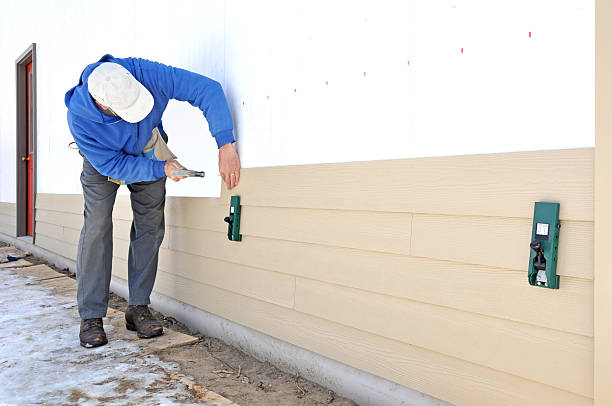
Not every blemish on wood siding means rot. Surface weathering, the gradual graying and surface checking that happens as wood is exposed to UV and moisture, is a natural process that does not compromise the structural integrity of the board. A board that has gone gray on the surface but is still firm under a probe or fingernail is a board that needs refinishing, not replacing.
True rot is soft, crumbly, or punky when pressed. It often carries a musty smell, and it typically appears first at end grains, bottom courses, and areas where water pools or vegetation contacts the siding. When you probe with a screwdriver or key and the wood gives way rather than resisting, that section has lost its structural integrity and needs to come out. The critical question is always how far the rot has traveled: into the sheathing, toward the framing. Our inspections use moisture meters and probing to determine the actual extent before any cutting begins.
When Engineered Wood Is the Smarter Choice
Not every homeowner who wants a wood exterior is the right candidate for natural wood siding. If you travel frequently, have a busy household with limited time for seasonal upkeep, or your home faces heavy weather exposure that makes a 3-year refinishing cycle feel unrealistic, engineered wood products like LP SmartSide are worth serious consideration. They use real wood strands bonded with resin and treated for moisture and fungal resistance, and they carry factory warranties that solid wood cannot match.
LP SmartSide accepts paint and stain in the same way solid wood does. From the street, the difference is minimal. The maintenance reduction is real: you are looking at 5-7 year refinishing cycles rather than 3-5, and the risk of individual board rot failures is substantially lower. For Ruther Glen homeowners who want the warmth and texture of a wood exterior without the full maintenance commitment, it is the honest recommendation we make regularly. We install both, and we tell you which one fits your actual life rather than pushing the product with the higher margin.